Growth Infrastructure by D14 Agency
When You’re Ready to Stop Patching and Start Building.
D14 installs full Growth Infrastructure — aligning CRM, AI, automation, and revenue tracking into one durable operating system for your business.
For operators building for the next decade — not the next campaign.
Selective strategic engagements for $1M+ service businesses.
Revenue Infrastructure Overview
Multi-layer view across CRM, AI workflows, pipeline stages, and booked revenue — designed as an operating system, not a dashboard theme.
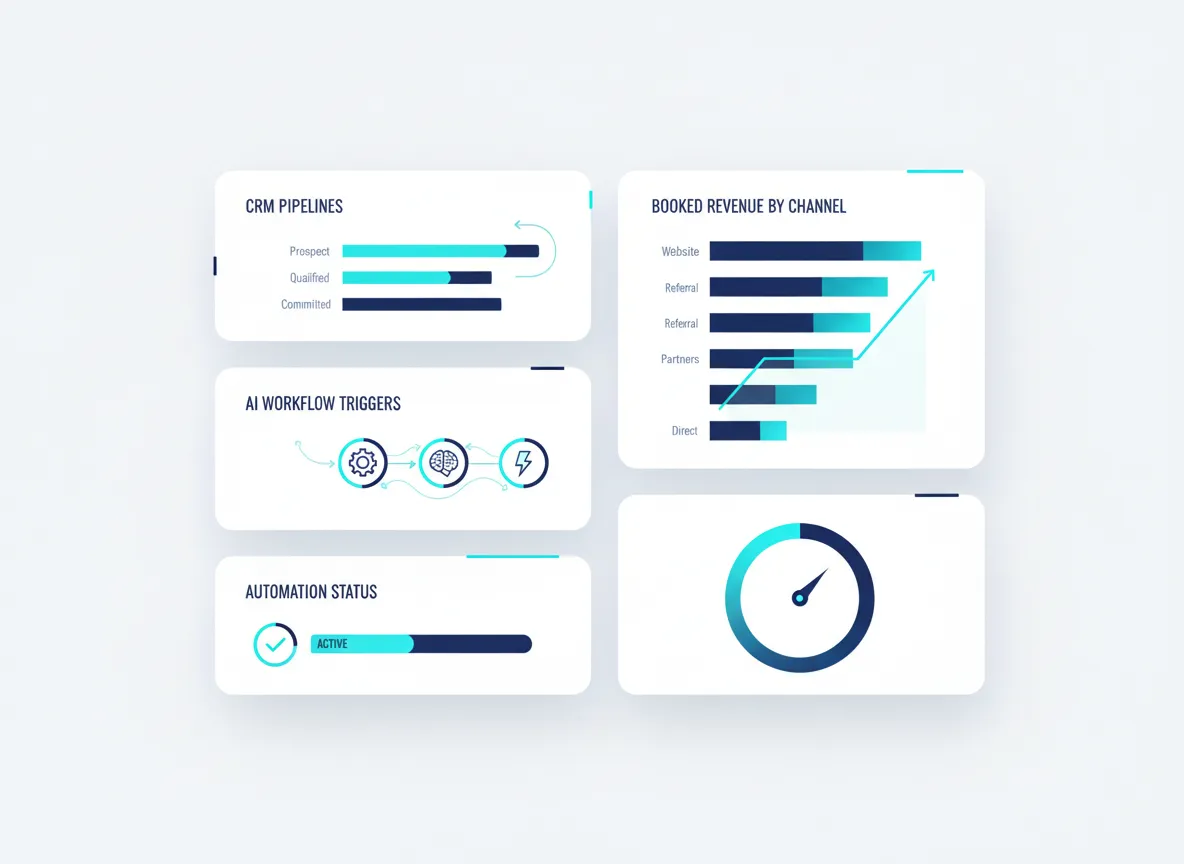
Concept visualization. Actual infrastructure is designed around your specific revenue model.
The Real Problem
Most Growing Businesses Break Under Their Own Complexity.
Growth introduces tools.
Infrastructure determines whether they work together:
• Too many tools solving narrow problems
• Disconnected CRMs that no one fully trusts
• Different agencies managing isolated pieces of the journey
• No single, reliable view of revenue across channels
• Leadership trapped in coordination instead of direction
Revenue doesn’t stall because of demand.
It stalls because infrastructure can’t support growth.
Symptoms You May Recognize
• Weekly fire drills to understand where revenue is coming from
• Manual exports just to answer basic questions
• Sales, marketing, and ops working from different realities
• No clean way to model the impact of new channels
Infrastructure is the constraint — not ideas, not demand.
What Growth Infrastructure Means
This Is Revenue Architecture.
Growth Infrastructure is a complete revenue operating system — not a single platform or automation. It aligns how demand is captured, qualified, converted, and measured across your entire business.
1. CRM Architecture
Structured pipelines aligned to your real revenue model — not generic stages. Every lead, opportunity, and account mapped to how your business actually works.
2. AI Deployment
Voice AI, automation logic, and intake systems put into production — not left in documents. Clear roles for where AI supports teams and where humans lead.
3. Automated Operations
Lead routing, follow-up, reactivation, and retention defined as systems. Clear logic, consistent execution, and fewer opportunities lost in handoffs.
4. Revenue Visibility
Dashboards that track booked revenue, pipeline value, and performance by channel. One source of truth leadership can use to make calm, confident decisions.
Installed around your real revenue model — not generic stages.
Most businesses buy tools. We design systems.
How It Connects
From First Contact to Closed Revenue — Connected.
We design infrastructure across the full revenue journey so that every interaction — human or automated — is part of one connected system:
• Intake
• Qualification
• Booking
• Follow-up
• Sales
• Retention
• Reactivation
All inside one infrastructure that your team can understand, operate, and improve.
One model. One system. One revenue view.
This eliminates handoff friction and leadership micromanagement.
End-to-End Revenue Flow Diagram
Visualizing how leads move from first touch to booked revenue — including AI touchpoints, human decisions, and system automation.
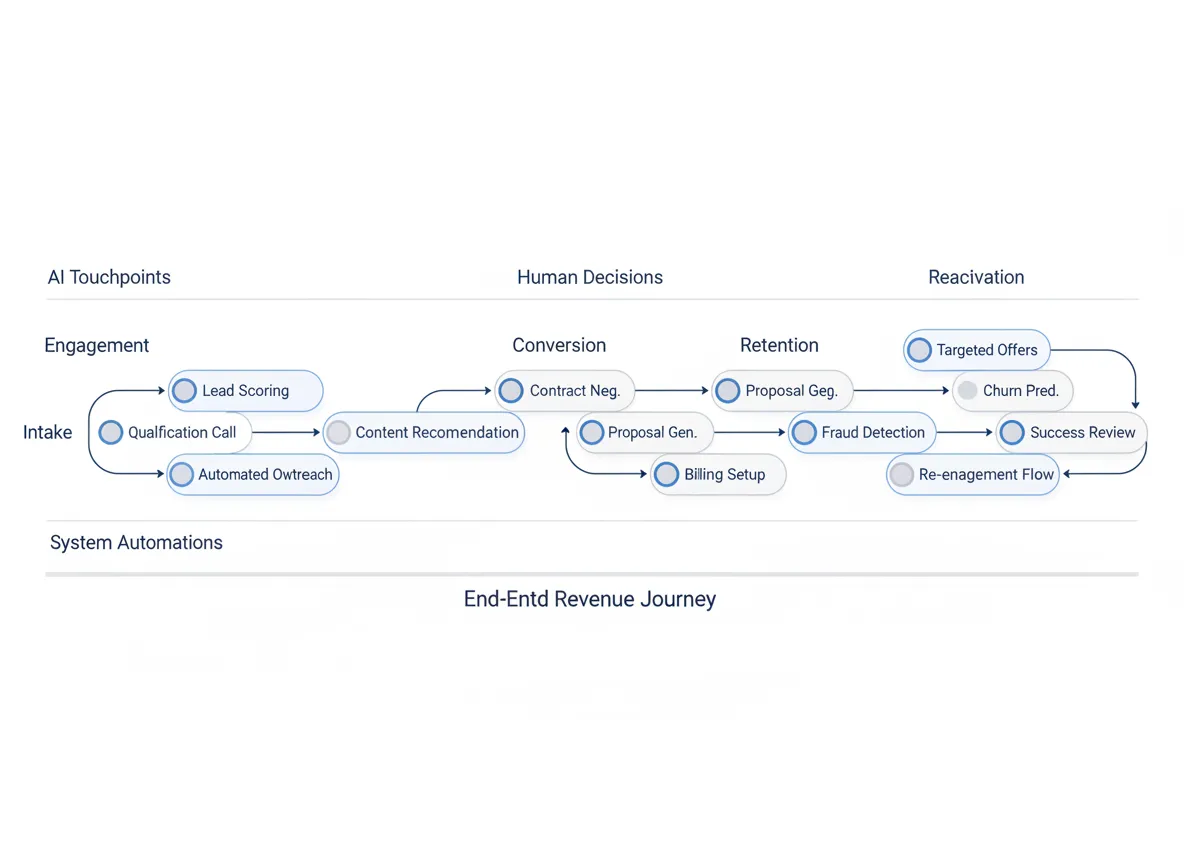
Used in working sessions to align leadership, sales, marketing, and operations on one shared system.
Who This Is For
Built for Operators Scaling Beyond $1M.
Growth Infrastructure is designed for service businesses that already have demand — and now need systems that can carry it.
- $1M–$5M annual revenue
- Multiple marketing channels already in play
- CRM in place (even if messy or underused)
- Leadership team or internal staff operating daily
- Ready for structured execution, not experimentation
Not for startups. Not for businesses still validating demand.
Strategic infrastructure engagement — implementation-led, not advisory-only.
After Installation
What Changes When Infrastructure Is Installed.
The outcome is not a campaign.
It is a controllable business.
• Revenue becomes measurable across channels
• Teams operate from one system, not scattered workarounds
• AI handles repetitive front-end work and coordination
• Missed opportunities decline as follow-up becomes systemized
• Leadership regains strategic bandwidth and cleaner signal
• Systems continue to perform without constant pressure from the top
Execution that holds — without eroding leadership.
Different From Agency Work
This Is Not Agency Work.
Agencies are valuable for running campaigns. Growth Infrastructure is a different layer — the operating system those campaigns run on.
Typical Agency
• Runs campaigns
• Sends reports
• Adds vendors and tools over time
• Focuses on traffic and top-of-funnel metrics
Growth Infrastructure
• Designs revenue operating systems
• Installs automation and AI layers
• Aligns teams around a unified revenue model and metrics
• Tracks cash flow, margin, and capacity — not just clicks
• Protects leadership bandwidth
Engagement Process
Structured. Strategic. Controlled.
Engagements are designed to protect execution quality and leadership time. Each phase has clear outcomes and owners.
Step 1: Strategic Review
Deep review of revenue model, current systems, channel mix, and operational constraints. We identify where infrastructure is carrying growth — and where it is leaking.
Step 2: Architecture Design
We map the end-to-end infrastructure: CRM structure, automations, AI roles, routing logic, and reporting. All aligned to clear revenue and capacity targets.
Step 3: Installation & Deployment
CRM rebuild or reconfiguration, automation build-out, AI deployment, and integrations. Clear rollout plans so teams are trained and systems go live in sequence.
Step 4: Measurement & Optimization
We implement revenue tracking, validate data integrity, and refine automation and AI behavior based on real usage and performance.
This is a build phase — not a marketing sprint.
Typical implementation window: 60–90 days depending on complexity.
FAQ
Questions Serious Operators Ask.
Growth Infrastructure is a focused engagement. A few common questions:
Is this replacing our marketing?
No. Growth Infrastructure does not replace your marketing — it aligns and strengthens it. Campaigns perform better when they run on a coherent system with clean data, defined handoffs, and reliable follow-up.
Do we need to change platforms?
Sometimes we optimize your existing stack, sometimes we rebuild. The decision is driven by your revenue model, current performance, and the cost of maintaining workarounds compared to building correctly.
How long does implementation take?
Most engagements run 60–90 days from initial review to stable deployment. Timelines depend on complexity, existing systems, and internal capacity for change management.
Is this a retainer?
No. Growth Infrastructure is a structured engagement with defined installation phases. Some clients choose ongoing advisory support after installation, but it is not required.
What kind of results should we expect?
The primary outcomes are measurable revenue clarity, fewer dropped opportunities, and more controlled operations. That typically shows up as cleaner data, more predictable pipeline, and leadership with better signal and less noise.
Strategic Engagement Review
Build Infrastructure That Compounds.
Install systems that support growth — without increasing operational chaos.
Selective engagements. Built for operators ready to implement.
On this call we will:
1. Review current systems and revenue model
2. Identify structural bottlenecks
3. Outline an infrastructure roadmap
4. Determine engagement fit and timeline
THE D14 ECOSYSTEM




© Copyright 2026. The D14 Agency, Forever Practice, and The CEO & The Carpenter. All Rights Reserved.